
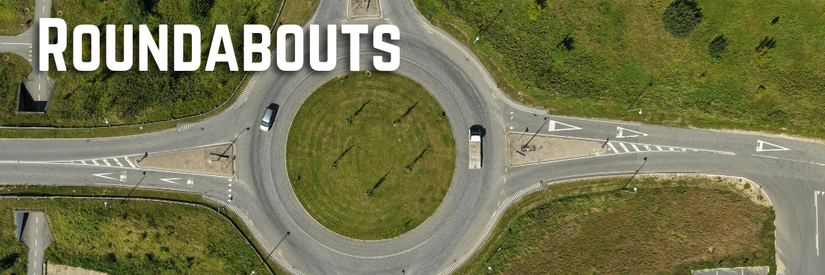
Roundabouts
Introduction
This website page is used only to provide public education regarding the history of roundabout discussions, as well as public education on roundabouts themselves. To date, there is no movement forward in regards to the installation of a roundabout, nor has it been decided to move forward with signal replacement.
Current Status
The traffic signals at the intersection of King's Highway and Central Avenue are beyond the end of their service life and require replacement. Replacement parts for the existing signals are no longer available, and it is anticipated that the system will eventually fail if it is not upgraded. Also, there are currently no pedestrian lights at this busy intersection. The 2026-2030 term of Council will need to make the decision to either move forward with a roundabout, or install new signals.
Background
- Administration approached Council, after a failed grant application to undertake a study to determine which intersection design would be best for this intersection. Council agreed to a study which considered whether a single-lane roundabout, double-lane roundabout, or traffic signal replacement was best for the intersection.
- The cost of this study was covered by the Town of Fort Frances as a requirement for a successful Connecting Link application: an Ontario grant program that helps fund roads and bridges which lie on a provincial highway.
- The study considered traffic volumes, pedestrian volumes, delays, and projected growth. It was presented to Council November 2025. It can be found here.
- The study considered alternatives, however it did recommend a roundabout for the following reasons:
- Addresses delays, which their study did review peak hours and did find at times the signals did not accommodate demand, before considering any population growth
- Accommodate pedestrians
- Improve safety
- Improve the travel paths for large trucks
- Roundabouts have a longer service life than signals, so although the initial cost is higher, replacement won't be as soon as signals
- There are no ongoing costs for electricity and maintenance (signals require electricity)
- There's less fuel consumption and pollution due to vehicles idling
- The study also recommends a next step before Council makes their decision: to move forward with a functional design of the roundabout to determine the location, and proceed with public and stakeholder engagement. This work was not awarded by Council in Spring 2026, and therefore this step has not yet happened.
Concerns and Responses
We understand that the public may have concerns about the possibility of a roundabout. This is understandable as frequent drivers of this intersection may not understand the reasoning for the potential change. Here are some of the concerns, and our responses to them:
A roundabout is more expensive than signals
This is true. The roundabout is estimated to cost $4 million, more initially than signals at $3 million. But both will require substantial reconstruction. A roundabout will also cost less long-term than signals. Signals require regular component replacement and continual maintenance, as well as ongoing electricity costs. Roundabouts, once installed, will only require routine road maintenance, the same as a signalized intersection. There is a provincial grant that would cover up to 90% of construction costs, which this intersection would qualify for provided the installation is compliant with relevant engineering standards. It will not be solely on municipal tax dollars to fund this.
The signals work well as is
The signals do require replacement as they're beyond end of life, and currently they do not have pedestrian signals and don’t meet engineering standards. At peak hours, there can be delays, while a roundabout would allow for continuous traffic flow. The study also suggests for future population growth, a roundabout could support higher traffic volumes. It's wonderful that some residents are supportive of the signal system and feel that they work well, but a roundabout may provide room for improvement as suggested through the study.
There is no space for a roundabout
There are smaller roundabouts in Northwestern Ontario and Minnesota which accommodate large trucks (including semi) traffic. The size is designed to allow these large vehicles. Roundabouts also integrate truck aprons for those that require a larger turning radius.
There will be traffic jams due to the line for the US Border
Actually, the line for the US border is suggested to divert before the roundabout starts removing that traffic from regular community traffic navigating around town. This would address vehicular conflict between US border wait lines and community traffic trying to get to Scott Street potentially bringing more traffic to Scott Street as well, showcasing our local businesses.
Nobody will know how to use a roundabout
Roundabouts are becoming more common, and can be found in Minnesota, Thunder Bay, Kenora, Winnipeg, and other places our residents frequent. It is suggested to have a one-lane roundabout which is easier for drivers to navigate as well as proper and clear signage to support navigation. There are great videos and instructions which can be found on YouTube and online which educate drivers on roundabouts if drivers are still uncertain. One other benefit is when the power is out, operations of a roundabout will not change, whereas drivers may face confusion when traffic signals are not working properly.
There will be more collisions
Roundabouts are actually determined to be safer than signals! They're known to reduce the amount of vehicular and pedestrian collisions and fatalities, with reported injuries being reduced by 75% and fatalities being reduced by 90%. This is because all vehicles travel in the same direction, never crossing paths, and the slower speeds give drivers more time to react and make decisions.
Public Engagement
There are currently no public consultations scheduled regarding this intersection. The next term of Council will be responsible for deciding whether to pursue a roundabout, replace the existing traffic signals, or explore other options.
If further study is undertaken, residents, businesses, and stakeholders will have opportunities to provide feedback before Council makes a decision.
Until then, residents are encouraged to review the information on this page, read the study, and discuss the future of this intersection with Council candidates during the upcoming municipal election.
 © 2025 The Town of Fort Frances